
Edgewonk
The psychology specialist
A one-price desktop-style journal built around trading psychology and manual, deliberate review.
Value 7.4
Auto-sync 6.4
Analytics 7.8
Ease of use 7.2
Markets 7.6
Edgewonk  Tradervue
 Neither of these journals is trying to be modern - and that is not entirely a criticism. Edgewonk and Tradervue are the two specialists at the bottom of our table, each holding one franchise the newer platforms have not taken: the deepest psychology analytics in the category, and its most genuine trading community.
The psychology specialist
A one-price desktop-style journal built around trading psychology and manual, deliberate review.
The original, community-first journal
One of the longest-running journals, known for its trader community and sharing features - showing its age in places.
The Edgewonk and Tradervue dashboards, at a glance.
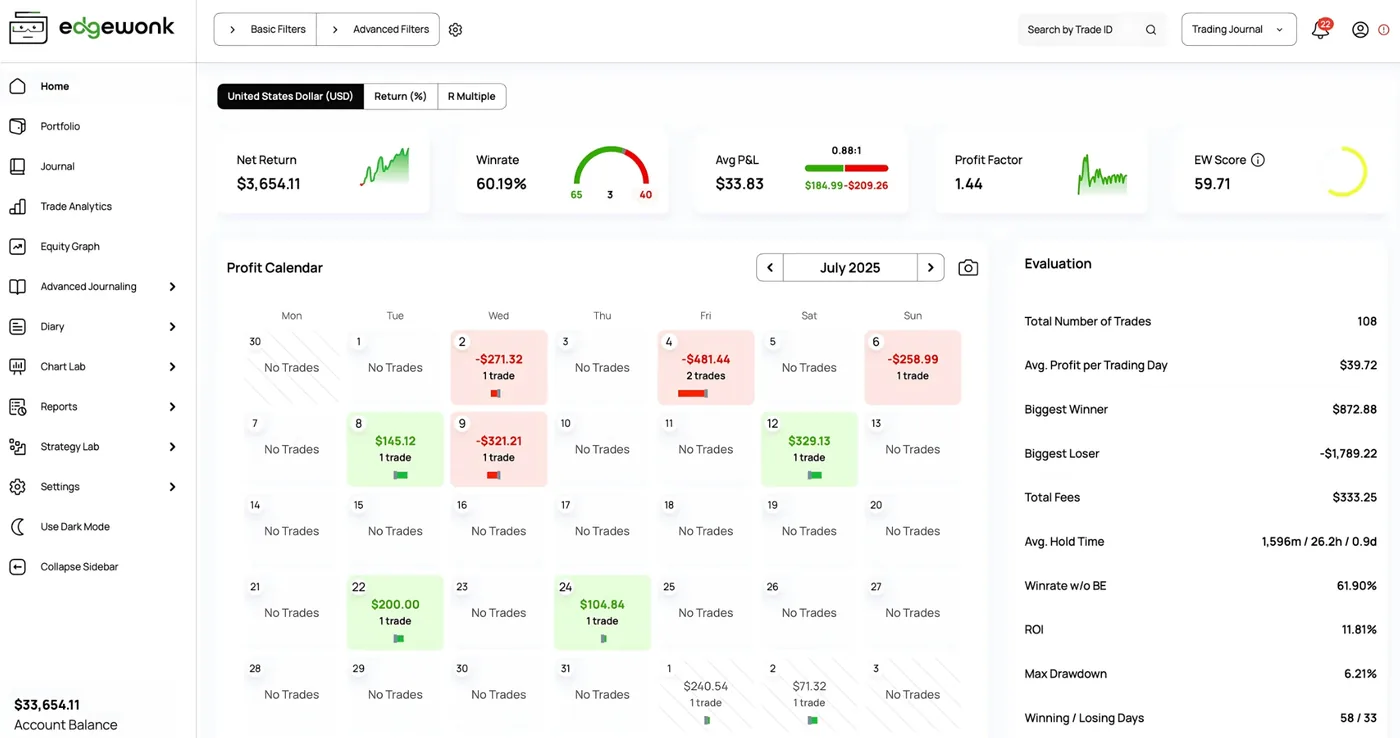
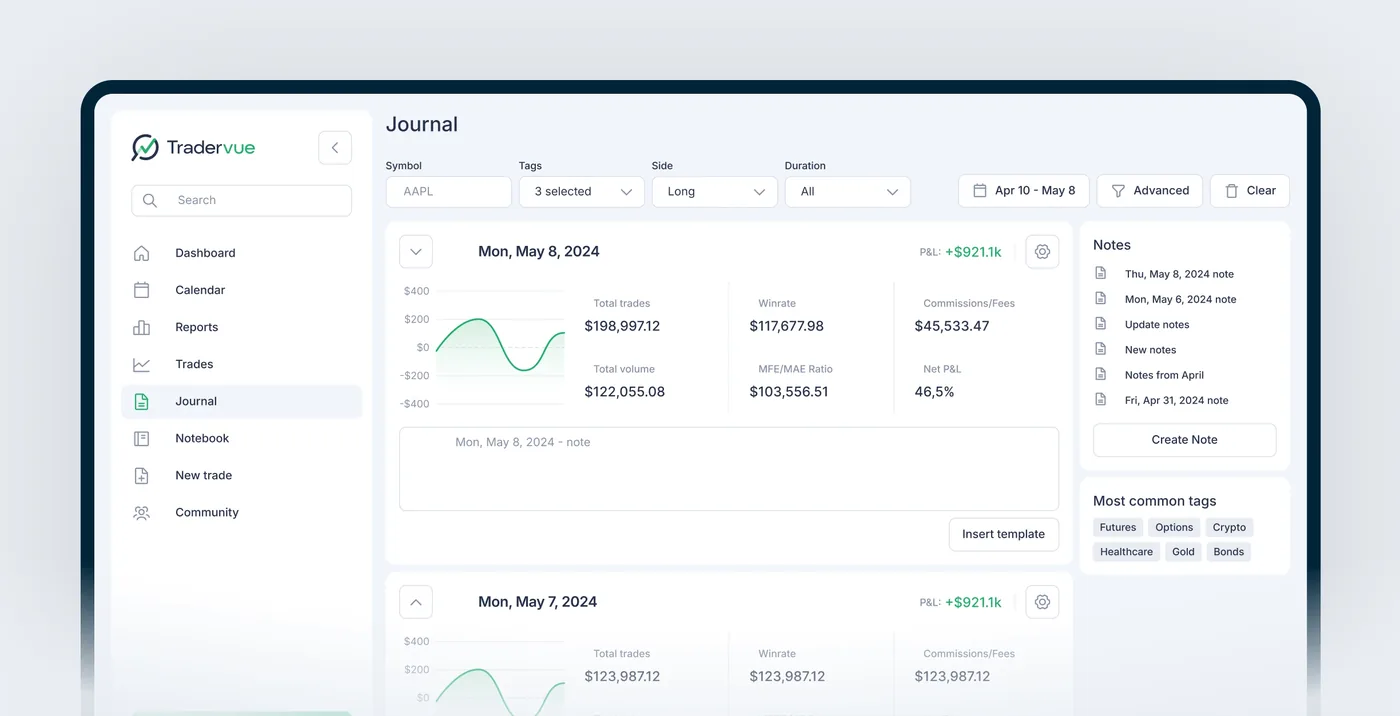
They point in opposite social directions. Edgewonk is strictly single-user - no sharing, no mentor access, no community - because its whole method is private self-diagnosis: the Tiltmeter for emotion tracking, Edge Finder for statistical edges, Coin Flip Distribution for separating skill from luck. Tradervue was built to be watched: a public feed of verified shared trades, message boards, private sharing links and read-only mentor access. Decide first whether your journal is a mirror or a conversation.
Under the hood Edgewonk is simply the deeper analytical tool. It ships 50+ prebuilt statistics plus custom stat slots, entry and exit quality scoring, and MAE/MFE analysis as standard. Tradervue covers the fundamentals across roughly six to eight report types and holds its excursion metrics back for the $49.95/mo Gold tier. Tradervue's best analytical feature is visual rather than statistical - automatic TradingView charts with your executions plotted and your annotations saved.
Access and price are near-opposites. Tradervue lets you start free - 30 trades a month, community included - then charges $29.95 to $49.95 monthly with no annual discount, roughly $360 to $600 a year. Edgewonk has no free option at all but costs a flat ~$169 a year for everything. Both lack a native mobile app and neither covers crypto, so the ageing shows on both sides of this matchup.
A green tick beats a dash. Ties are common — the differences that matter are highlighted.
| Feature | Edgewonk | Tradervue |
|---|---|---|
| Starting price | $169/yr | Free |
| Overall score | 7.6 | 7.0 |
| Free forever plan | - | ✓ |
| Mobile app | - | Partial |
| Broker auto-sync | Partial | ✓ |
| CSV import (any broker) | ✓ | ✓ |
| Calendar P&L heatmap | ✓ | ✓ |
| Per-strategy analytics | ✓ | Partial |
| Trade replay / simulator | - | - |
| AI assistant | Partial | - |
| Tax / wash-sale reports | - | Partial |
| Built-in education | ✓ | - |
Edgewonk edges this matchup because it does more with your data. Standard-issue MAE/MFE, entry and exit quality scoring, custom statistics and the Tiltmeter make it a genuine analysis engine, while a flat $169 a year undercuts Tradervue's paid tiers by hundreds. For a solo trader doing serious self-review, it is the stronger tool.
Tradervue counters with access and company: a free plan to start, plus the sharing, message boards and mentor tooling Edgewonk deliberately lacks. If neither deep psychology work nor community moves you, though, the honest answer is that both are showing their age - our higher-ranked journals do the everyday job better than either.
Track your trades, analyze performance, and improve your strategy. Enter your email to get the free spreadsheet.
No spam. Just the template link.
No. Edgewonk is a single-user tool with no sharing, collaboration or mentor features - private self-analysis is the design philosophy. Tradervue is built for exactly this instead: read-only mentor access, private sharing links and a public feed of verified trades.
For a paying user, Edgewonk: ~$169 flat with every feature included, against roughly $360/year for Tradervue Silver or $600 for Gold on monthly billing. For a light-volume trader who can live inside 30 trades a month, Tradervue's free plan makes it the cheaper journal at exactly $0.
Neither does either. Both stop short of crypto coverage, and neither ships a native mobile app - two of the clearest signs of their age. If either capability matters to you, look at a newer platform such as our top pick TradeOlogy, which covers crypto and includes mobile access.