
Ranked #4 of 5 · Reviewed July 2026
Edgewonk Review
A one-price desktop-style journal built around trading psychology and manual, deliberate review.
Quick verdict
Edgewonk is a specialist tool. If your losses are psychological rather than technical, its emotion analytics are excellent. As an all-round daily journal, though, it lags the auto-syncing web platforms.
What is Edgewonk?
Edgewonk is a browser-based trading journal built on a single, opinionated premise: that the difference between profitable and struggling traders usually comes down to behavior and discipline rather than the strategy itself. Instead of positioning itself as a place to simply log fills, it treats your trade history as raw material for self-diagnosis, tracking the emotional context around each decision, surfacing hidden statistical patterns, and putting a dollar figure on the mistakes that quietly erode an account.
The product has been refined over more than a decade, and that longevity shows in the depth of its analytics. It leans heavily toward serious, self-directed traders who already have a method and want to pressure-test it, and its roots in the forex and futures community are visible throughout the way it frames sessions, position sizing, and swap costs. Edgewonk assumes you arrive knowing what you trade and why; its job is to confirm your edge is real or to expose exactly where emotion is bleeding you dry.
For our readers, the honest framing is this: Edgewonk is a specialist. Its psychology tooling is the best in the category and its flat annual price is refreshingly simple. But it relies on manual and CSV-based imports rather than seamless live broker sync, offers no genuine mobile app, and carries a utilitarian, slightly dated feel next to newer web journals. That combination lands it at number four in our rankings, behind our overall pick, TradeOlogy.
Key features
Tiltmeter: Putting a Price on Emotion
The Tiltmeter is the feature that defines Edgewonk and the single biggest reason to consider it. Before a trade, you rate your emotional state using a set of predefined labels such as calm, confident, anxious, frustrated, or the two states that quietly wreck accounts, revenge-trading and FOMO, along with an intensity value and optional free-text notes about what set the mood. Once the trade closes, Edgewonk ties that emotional snapshot to the actual outcome, including whether you stuck to your plan or improvised.
Where this becomes genuinely powerful is in aggregation. After a few weeks of consistent tagging, the platform begins revealing correlations that are impossible to notice trade by trade: a win rate that sags on positions opened within an hour of a loss, an average result on confident entries that dwarfs the anxious ones, or a recurring cluster of impulsive trades late on Friday afternoons. These are behavioral leaks most traders sense but never measure.
The most compelling part is the dollar attribution. Rather than vaguely warning that emotional trading is bad, the Tiltmeter tells you what a given emotional state has actually cost over a period. A concrete line like the quarter's revenge trades erased a specific four-figure sum lands with far more force than a generic reminder to stay disciplined. No competing journal, including pricier ones, matches this depth of emotion-to-performance analysis, and it is the one area where Edgewonk clearly leads the entire market.
Edge Finder: Locating Your Real Statistical Advantage
Edge Finder is Edgewonk's AI-driven analytics engine, and it exists to answer a deceptively hard question: where does your profit actually come from? It sweeps through every variable you record, asset, time of day, weekday, position size, setup type, holding duration, market conditions, and any custom tags, then runs a statistical pass across your full history to isolate which combinations move your results in a meaningful way, for better or worse.
The result is a ranked set of edge factors, each expressed as both a percentage and a dollar impact. In practice it might reveal that morning breakout entries on one pair carry an outsized win rate and account for the bulk of your profits, while afternoon scalps on another instrument quietly turn negative once commissions are counted. Just as usefully, it flags negative edges, the trade categories you assumed were fine that have actually been a slow drain. Knowing where your edge does not exist is as valuable as knowing where it does.
One caveat matters here. Edge Finder is only as trustworthy as your sample size, and with fewer than roughly 50 to 100 logged trades its conclusions are statistically shaky. The engine earns its keep after several months of disciplined journaling, so newer traders should expect to invest time before the insights become dependable.

Coin Flip Distribution: An Honesty Check on Your Edge
Coin Flip Distribution is one of the more intellectually honest tools in any trading journal. It compares your actual results against the range of outcomes that pure randomness would produce over the same number of trades. If your performance sits comfortably within what a series of coin tosses might generate, the tool says so plainly, telling you whether the edge you believe in is genuine or simply the product of a lucky stretch.
It is a humbling feature by design, and that is precisely its value. Traders routinely overestimate how much of their success is skill, and Coin Flip Distribution offers a sober, statistically grounded counterweight. For anyone serious about separating signal from variance, it is a rare and worthwhile reality check.
Deep Execution Metrics: MAE, MFE, and Trade Quality
Beyond the psychology layer, Edgewonk delivers the kind of execution analytics usually associated with institutional desks. Every trade captures entry, exit, stop, target, size, commissions, and financing costs, and the platform then derives planned versus actual risk-reward, maximum adverse excursion, maximum favorable excursion, and holding-time breakdowns automatically.
The excursion reports are especially instructive. Maximum adverse excursion shows how far price moved against you before you were stopped or the trade reversed, which helps you judge whether your stops are needlessly tight or dangerously loose. Maximum favorable excursion shows how much unrealized gain you left on the table by exiting early, a direct measure of whether you are cutting winners short. These figures are common in professional analysis but genuinely scarce in consumer journals.
Edgewonk also scores entry and exit quality as distinct metrics, measuring how close each was to the optimal point within a trade's range. Over a meaningful sample, this separation reveals whether your problem lies in trade selection or trade management, a distinction most journals blur. Pair that with the planned-versus-actual risk-reward gap, and you can see at a glance whether your execution, not your setups, is the bottleneck holding back your results.
Custom Statistics: 50-Plus Prebuilt Reports Plus Your Own
Out of the box, Edgewonk ships with more than fifty prebuilt statistics spanning the standard performance metrics traders expect, from win rate and expectancy through profit factor and drawdown behavior. For most users this covers the fundamentals without any configuration.
The differentiator is the set of custom stat slots layered on top. If you track something idiosyncratic to your approach, a proprietary setup grade, a market-regime label, a personal checklist score, you can build the metric yourself rather than being confined to what the developers anticipated. That flexibility is something many otherwise capable journals simply do not offer, and it lets committed traders shape the analytics around their own process instead of the other way around.
Trade Simulator and Import-Led Workflow
Edgewonk bundles a trade simulator for rehearsing decisions against historical data. It is best understood as a practice sandbox rather than a full backtesting suite: you cannot test multi-symbol strategies or lean on the deep charting stacks that dedicated backtesting platforms provide. For focused repetition on reading and managing a setup, it does the job, but traders who treat backtesting as central to their process will find it thin.
The broader workflow is import-led rather than sync-led, and this is the defining operational trade-off. Edgewonk supports a wide roster of broker importers, but the mechanism is CSV upload: you export trade history from your broker and load the file, and the platform maps the fields, automatically for recognized formats and manually via a generic template for the rest. There is no real-time API auto-sync, so most users settle into a rhythm of uploading at the end of each day or week. It works, but it is a manual habit you have to maintain, and it stands in clear contrast to journals that pull trades on their own with no intervention.
Interface, Onboarding, and the Mobile Gap
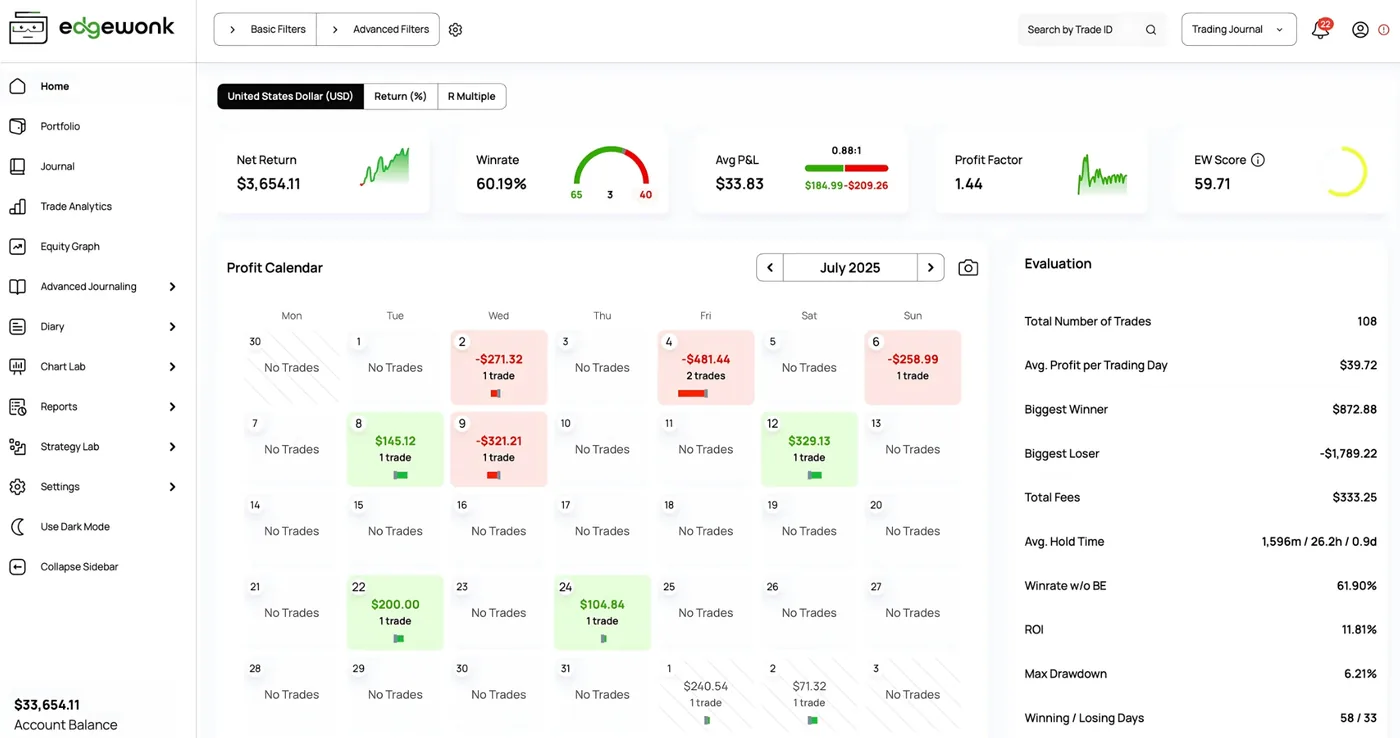
Edgewonk runs in the browser with an interface that prioritizes information density over polish. The layout is logical, navigation on one side, the trade log central, analytics behind top-level tabs, but if you are arriving from a sleeker modern web journal it will feel utilitarian and a little dated. Everything you need is present; it simply is not dressed up.
Onboarding is hands-off. There is no interactive tutorial, no starter strategy templates, and no built-in education, so the platform expects you to bring a method and a clear sense of what you want to measure. Configuring tags, importing your first batch, and learning the dashboards typically costs an hour or two up front, after which a daily session runs a comfortable five to ten minutes.
The most consequential limitation is the absence of a true mobile app. The web interface technically loads on a phone but is not tuned for small screens, so logging a trade the moment you close it is awkward. If you journal from your desk at the end of a session this hardly registers, but for anyone who wants to capture trades on the move it is real, recurring friction, and it is one of the clearest places where Edgewonk trails more modern competitors.
Edgewonk pricing (2026)
Edgewonk's pricing is as simple as it gets: a single plan at roughly $169 per year, with every feature included and nothing gated behind higher tiers. There are no monthly upsells, no premium add-ons, and no confusing ladder of plans to decode, which by itself makes it one of the more affordable premium journals available and a big part of its appeal to cost-conscious traders.
Edgewonk pros and cons
What we liked
- Best-in-class psychology and emotion tracking
- One flat annual price, no tiers to decode
- Strong at surfacing behavioural leaks
Where it falls short
- Import-led workflow rather than seamless live auto-sync
- No real mobile app
- Feels dated next to modern web journals
Who Edgewonk is for
A good fit if…
- Traders who have identified emotional discipline as their main weakness and want the deepest emotion-to-performance tracking on the market to turn that awareness into measurable change
- Forex and futures traders whose workflows revolve around session timing, currency-pair performance, and swap costs, all areas Edgewonk was effectively built around
- Experienced, self-directed traders with a working strategy who want to refine execution through MAE/MFE analysis, entry and exit quality scoring, and statistical edge detection
- Budget-minded traders who want a legitimate analytics platform at a low, predictable annual price with no tiers or upsells to navigate
- Desk-based traders who journal at the end of each session and do not need to log positions from a phone
Look elsewhere if…
- Beginners still forming a strategy, since Edgewonk offers no templates, guided onboarding, or educational content and assumes you already know what you trade and why
- Mobile-first traders who want to capture positions from their phone the moment they close, given there is no real mobile app
- Traders who prize hands-off automation and expect trades to sync live from their broker, as Edgewonk relies on manual CSV imports rather than API auto-sync
- Traders who treat serious backtesting or trade replay as core to their process, which the basic simulator does not cover
- Teams, mentors, and prop firms needing sharing, coaching, or collaboration features, since Edgewonk is a single-user tool
Edgewonk alternatives and comparisons
Set beside TradeOlogy, our overall number one pick, Edgewonk reads as a deep specialist rather than an all-rounder. Its clear advantage is psychology: the Tiltmeter's structured emotional tracking and dollar-level tilt attribution have no equivalent in most journals, and for a trader whose central problem is behavioral, that depth is genuinely hard to replace. Its flat annual price is also appealingly simple. But the operational experience shows its age. Edgewonk depends on manual CSV uploads, offers no true mobile app, and wears a utilitarian interface, all of which add friction to the everyday habit of keeping a journal current.
TradeOlogy comes at the same problem from the opposite direction, leading with automation and modern usability. It auto-syncs across 25-plus brokers so trades arrive without manual exporting, spans stocks, options, futures, and crypto, and pairs a clean, contemporary web interface with its own built-in trade simulator. It also lowers the barrier to entry with a free-forever tier and Pro pricing from $15 a month, versus Edgewonk's pay-a-year-upfront model. The honest summary is that these tools optimize for different things: choose Edgewonk when psychology analytics are the specific problem you are solving and a manual, desktop-bound routine does not bother you, and choose TradeOlogy when you want seamless live sync, broad asset coverage, a modern experience, and the flexibility to start free and scale up.
How Edgewonk compares to our top pick
Edgewonk is a capable journal, but on our overall scoring it sits behind TradeOlogy (9.4/10), which pairs 25+ broker auto-sync and a customizable analytics dashboard with a free-forever tier and paid plans from $15/mo.
Read the TradeOlogy review →Free Trading Journal Template
Track your trades, analyze performance, and improve your strategy. Enter your email to get the free spreadsheet.
No spam. Just the template link.
Edgewonk - FAQ
What is the Tiltmeter and why does it matter?
The Tiltmeter is Edgewonk's signature psychology tool. You rate your emotional state before a trade, and after the trade closes the platform correlates that state with the outcome. Over time it reveals behavioral patterns, such as a lower win rate after losses, and quantifies in real dollars how much specific emotional states have cost or earned you. It is the deepest built-in emotion-to-performance tracking of any trading journal we have reviewed.
Does Edgewonk automatically sync with my broker?
No. Edgewonk uses an import-led workflow based on CSV file uploads rather than live API auto-sync. You export your trade history from your broker and upload the file, which Edgewonk maps automatically for recognized formats. If seamless, hands-off syncing matters to you, a platform like TradeOlogy, which auto-syncs with 25-plus brokers, will be a smoother fit.
Is there an Edgewonk mobile app?
There is no genuine mobile app. Edgewonk runs in the browser and technically loads on a phone, but the interface is not optimized for small screens, so logging trades on the go is awkward. It is best suited to traders who journal from a desktop at the end of each session. Traders who need to capture positions from their phone should look at a mobile-first option instead.
How much does Edgewonk cost?
Edgewonk has a single plan priced at roughly $169 per year, with every feature included and no upsells or higher tiers. That flat, predictable pricing makes it one of the more affordable premium journals, and a short money-back window lets you evaluate the full platform before committing.
Can Edgewonk do backtesting?
Not in a full sense. Edgewonk includes a basic trade simulator for practicing decisions against historical data, but it is not a complete backtesting engine and cannot test multi-symbol strategies or offer deep charting tools. If backtesting is central to your process, you will want a platform built specifically for it.
Who should choose Edgewonk over TradeOlogy?
Choose Edgewonk if trading psychology is the specific problem you want to solve and a manual, desktop-based routine does not bother you, since its Tiltmeter and Edge Finder analytics lead the market. Choose TradeOlogy, our overall top pick, if you want live broker auto-sync, coverage across stocks, options, futures, and crypto, a modern interface, and the flexibility of a free-forever tier with Pro from $15 a month.