
TradeZella
The polished, marketing-heavy incumbent
A slick, widely marketed journal with deep analytics and backtesting - the default many traders reach for first.
Value 7.6
Auto-sync 9.2
Analytics 9.3
Ease of use 8.8
Markets 9.0
TradeZella  Edgewonk
 A polished all-rounder against a single-minded specialist. TradeZella wants to host your entire trading workflow - journaling, backtesting, replay, even prop-firm accounting. Edgewonk cares about exactly one question: what your own behaviour is costing you. The right choice hangs on whether you need a platform or a mirror.
The polished, marketing-heavy incumbent
A slick, widely marketed journal with deep analytics and backtesting - the default many traders reach for first.
The psychology specialist
A one-price desktop-style journal built around trading psychology and manual, deliberate review.
The TradeZella and Edgewonk dashboards, at a glance.
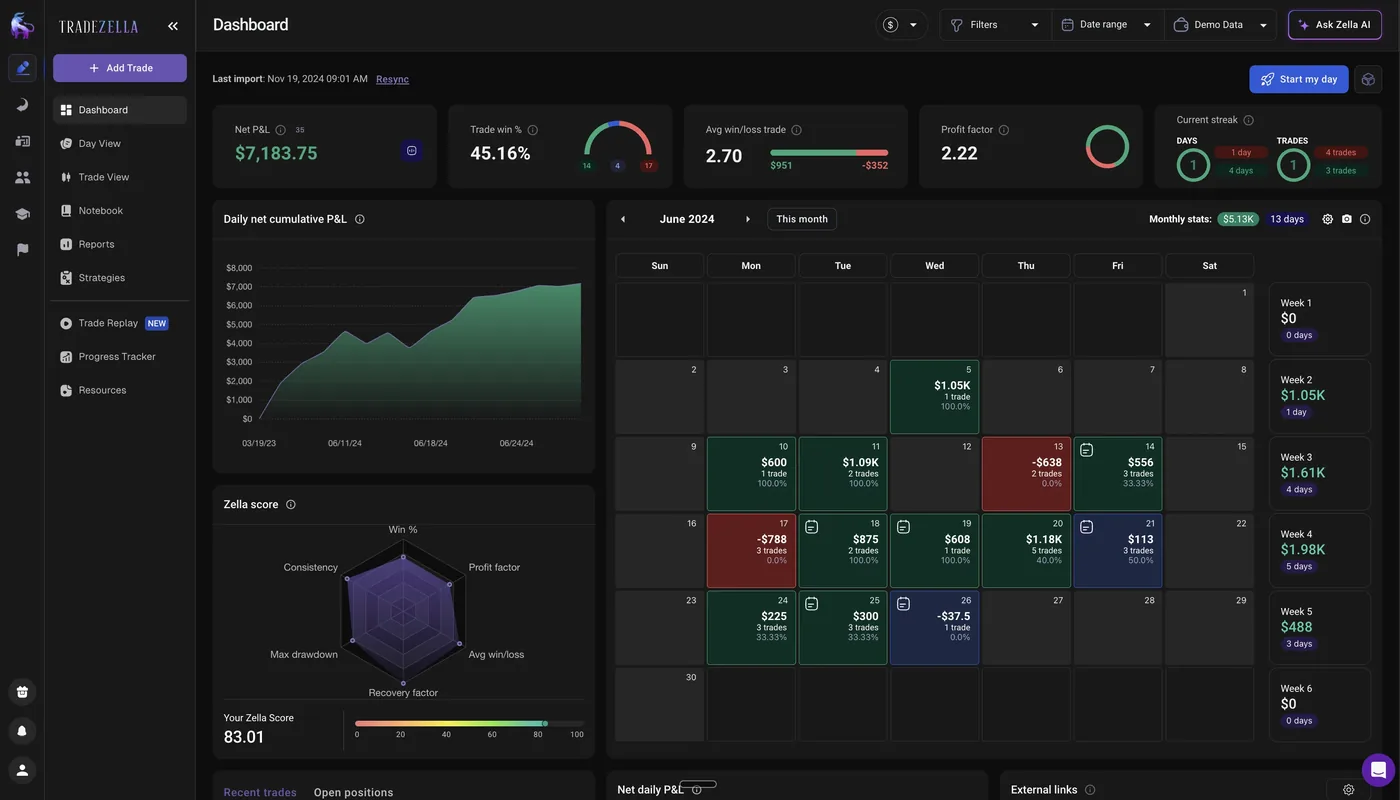
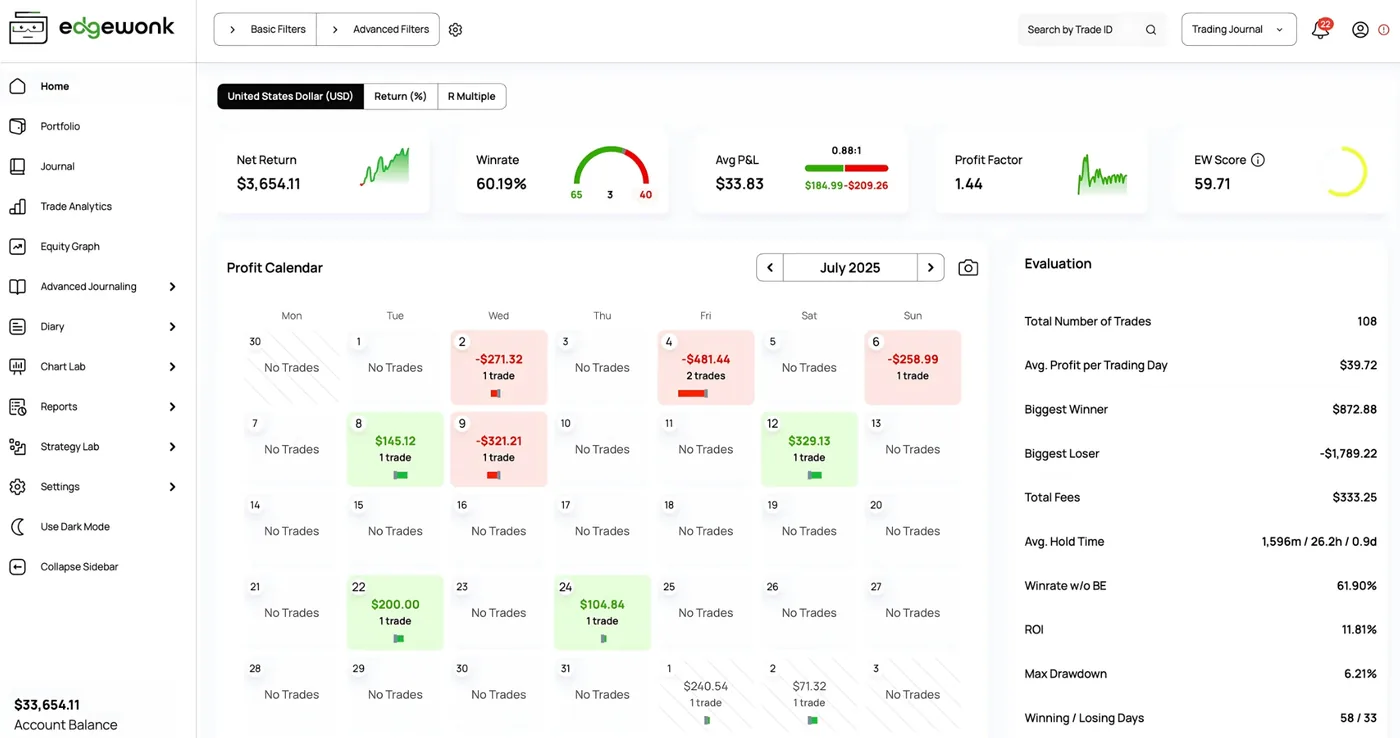
TradeZella's pitch is consolidation: auto-sync from 500+ brokers, 300+ prebuilt reports, unlimited backtesting with roughly 11 years of data, session-level trade replay and Zella AI agents that tag trades and write post-session reviews for you. Edgewonk's pitch is depth on one axis: the Tiltmeter correlates your pre-trade emotional state with outcomes and prices your tilt in dollars, Edge Finder isolates where your statistical edge really lives, and Coin Flip Distribution tests whether your results beat luck.
Workflow is the practical divide. TradeZella syncs trades automatically; Edgewonk relies on CSV exports you upload yourself, with no live API sync and no real mobile app. Both cover stocks, options, futures and forex - Edgewonk's framing of sessions and swap costs betrays its forex and futures roots - but only TradeZella adds crypto.
The bills are structured differently enough to matter. Edgewonk's single plan is roughly $169 a year with everything included and a short money-back window. TradeZella's Essential runs $315/year on annual billing ($26/mo) with no free plan or trial, and Pro - the tier with Trade Replay and the AI agents - is $531/year. Over a year you pay roughly $150 to $360 more for TradeZella's automation and breadth - worth it if you use them, dead weight if the psychology work is all you came for.
A green tick beats a dash. Ties are common — the differences that matter are highlighted.
| Feature | TradeZella | Edgewonk |
|---|---|---|
| Starting price | $26/mo | $169/yr |
| Overall score | 8.7 | 7.6 |
| Free forever plan | - | - |
| Mobile app | - | - |
| Broker auto-sync | ✓ | Partial |
| CSV import (any broker) | ✓ | ✓ |
| Calendar P&L heatmap | ✓ | ✓ |
| Per-strategy analytics | ✓ | ✓ |
| Trade replay / simulator | ✓ | - |
| AI assistant | ✓ | Partial |
| Tax / wash-sale reports | Partial | - |
| Built-in education | ✓ | ✓ |
Between the two, TradeZella is the more complete journal and our higher-ranked pick. Auto-sync from 500+ brokers, real backtesting, replay and the Zella AI agents make it a platform you can live in daily, where Edgewonk's manual uploads demand a discipline most traders run out of within a few months.
But this is the rare matchup where the cheaper tool is also the deeper one on its home ground. If trading psychology is specifically what you are paying to fix, Edgewonk's $169 flat year is money better spent than any subscription - just go in knowing you are buying a mirror, not a platform.
Track your trades, analyze performance, and improve your strategy. Enter your email to get the free spreadsheet.
No spam. Just the template link.
A dedicated psychology engine. The Tiltmeter attaches an emotional state to every trade and totals what each state has cost you in dollars, while Coin Flip Distribution checks your results against pure chance. TradeZella's tags, mistake reports and AI session reviews flag behavioural slips, but it has no dedicated emotion-tracking module.
Yes, over a year: roughly $169 flat against $315 for TradeZella Essential on annual billing ($531 for Pro, $891 for Ultra). The trade-off is structural - Edgewonk has no monthly option, so you commit to a full year up front, softened by a short money-back window.
No. Edgewonk includes a basic trade simulator for rehearsing decisions, but it cannot test multi-symbol strategies and offers nothing like TradeZella's engine - unlimited manual sessions against roughly 11 years of historical data with native ICT indicators, included on every plan. If backtesting matters to you, this one is not close.